TL;DR
- AI pricing in “$0.0004 per 1000 tokens” is hard to visualize.
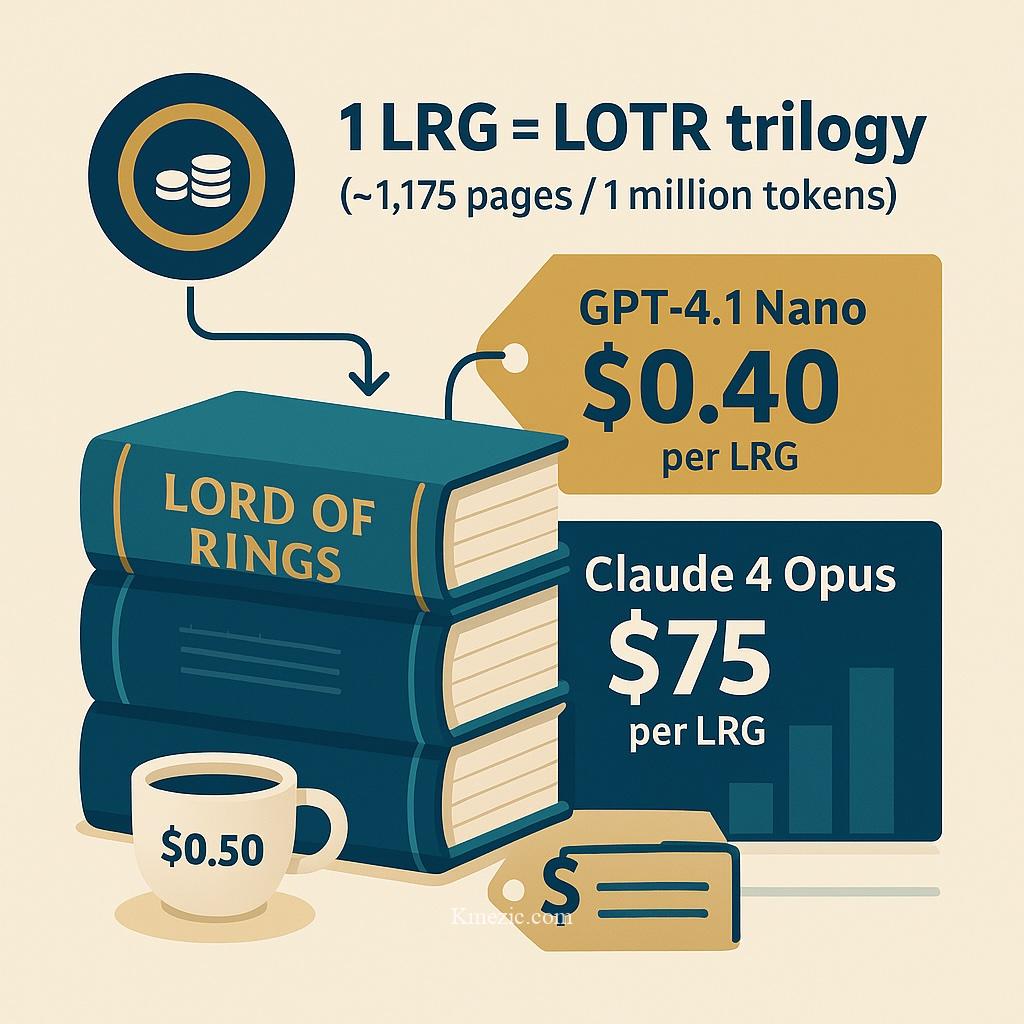
- What if we used “LRGs” instead? 1 LRG = generating the entire Lord of the Rings trilogy (~1 million tokens).
- Pricing becomes clearer GPT-4.1 Nano vs Claude Opus = $0.4 vs $75 LRG.
- Cheapest doesn’t mean best for your specific use case.
- Do we even care about pricing anymore?
Podcast
Background
Generative AI APIs bill in “tokens per 1K,” splitting prompt and completion costs into technical jargon that leaves users guessing their actual spend. Even experienced developers report that pricing pages list rates but not total tokens produced, making budgeting pure guesswork. Community threads consistently show that real-time API pricing confuses many users, with questions like “How much will this actually cost me?” going unanswered.
The root issue? Abstract token counts don’t translate to real-world understanding. When you see “$0.03 per 1K tokens,” your brain has to perform mental gymnastics to estimate costs for actual use cases.
Here’s what current AI pricing looks like per 1000 tokens:
- GPT-4.1 Nano $0.0004
- GPT-4o Mini $0.0006
- GPT-4.1 Mini $0.0007
- Gemini 2.5 Flash $0.001
- Claude 4 Sonnet $0.015
- GPT-4.1 $0.008
- Claude 4 Opus $0.075
- Gemini 2.5 Pro $0.010
Can you quickly tell which models offer the best value? Or estimate your monthly costs? The fractional rates make comparison and budgeting hard.
One Possible Solution: The LRG
What if we could anchor AI pricing to something everyone understands? Here’s an idea: the LRG (Lord of the Rings) – a unit where 1 LRG = 1 million completion tokens.
Why Lord of the Rings? Tolkien’s saga contains roughly 470,000 words (~1,175 pages), which translates to approximately 1 million tokens when processed by modern AI models. This could give us a literary benchmark that’s both memorable and substantial enough to represent real AI workloads.
Instead of wrestling with fractional token math, you might think: “How many Lord of the Rings’ worth of text do I need to generate?”
What This Might Look Like
Here’s the same pricing converted into LRG units:
- GPT-4.1 Nano $0.40
- GPT-4o Mini $0.60
- GPT-4.1 Mini $0.70
- Gemini 2.5 Flash $1
- GPT-4.1 $8
- Gemini 2.5 Pro $10
- Claude 4 Sonnet $15
- Claude 4 Opus $75
Note: These prices reflect completion token costs only. Most APIs also charge for input tokens, which typically cost 3-5x less.
Some Potential Benefits
- Cost Gaps Might Become Clearer: The 187.5× difference between GPT-4.1 Nano ($0.40/LRG) and Claude 4 Opus ($75/LRG) could be more immediately obvious. Less mental math to understand your model selection trade-offs.
- Budget Options Could Surface: GPT-4.1 Nano at $0.40/LRG represents what appears to be an ultra-budget tier that’s 37.5× cheaper than Claude 4 Sonnet’s $15/LRG – a difference that might get lost in fractional token pricing.
- Budgeting Might Become More Intuitive: Instead of calculating “tokens per dollar,” you could think “How many epic novels’ worth of content do I need?” and multiply by the LRG rate.
- Real-World Context: Generating a full Lord of the Rings trilogy (approximately 1,175 pages of text) would cost $75 with Claude 4 Opus but only $0.40 with GPT-4.1 Nano. This might help the premium for advanced models feel more tangible.
Important: Price ≠ Performance for Your Use Case
These LRG prices reflect cost per token, not quality or suitability for your specific application. The 187.5× price difference between GPT-4.1 Nano and Claude 4 Opus exists for a reason – they offer dramatically different capabilities.
Consider what you actually need:
- Simple tasks (basic summaries, simple Q&A): Ultra-budget models like GPT-4.1 Nano might be perfect
- Complex reasoning (analysis, coding, creative writing): Premium models could be worth 50-100× more per token
- Specialized domains (legal, medical, technical): Model choice matters far more than cost
The cheapest option isn’t always the best value. A $0.40 LRG that produces unusable output costs more than a $15 LRG that nails your task on the first try.
But Do We Even Care Anymore?
Looking at GPT-4.1 Nano at $0.0004 per 1K tokens ($0.40 for an entire Lord of the Rings), maybe the real question isn’t “How do we understand AI pricing?” but rather “Does pricing even matter when it’s this cheap?”
When you can generate a novel-length text for under 50 cents, perhaps we’ve reached the point where AI costs have become negligible for most use cases. The LRG framework might be more interesting as a way to grasp the sheer scale of what’s now possible for pocket change than as a budgeting tool.
What’s your take—are we overthinking pricing when the bottom tier models cost less than a cup of home brewed coffee for massive text generation?
Leave a Reply
You must be logged in to post a comment.